As industrial manufacturing facilities face growing pressure to reduce operational expenditures and eliminate coal emissions, industrial boilers are undergoing a rapid transition toward renewable biomass fuels.
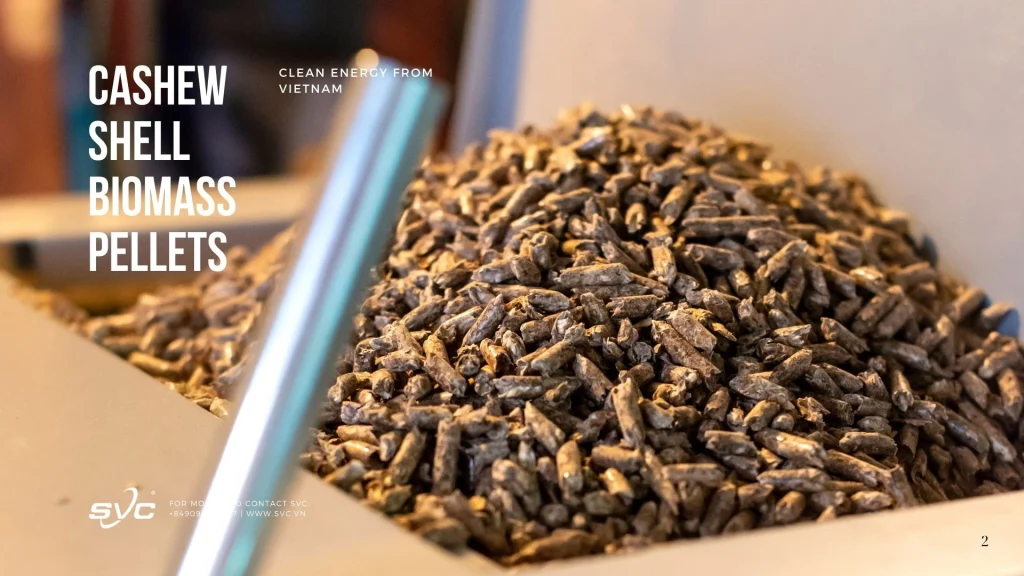
Among agricultural energy sources, Cashew Shell Biomass—available as compressed pellets (CNSP) or solid cake residue—has established itself as one of the most reliable, high-calorific alternatives for heavy-duty steam generation.
This technical guide explores how Cashew Nut Shell Biomass for Industrial Boilers, detailing combustion characteristics, furnace compatibility, emissions profiles, and overall cost efficiency.
Table of Contents
Technical Performance Snapshot in Industrial Boilers
| Operating Parameter | Cashew Shell Biomass (Pellets) | Standard Wood Pellets | Sub-Bituminous Coal |
| Gross Calorific Value (GCV) | 4,500 – 4,900 kcal/kg | 4,000 – 4,400 kcal/kg | 5,000 – 5,500 kcal/kg |
| Flame Temperature Profile | High & Sustained | Moderate | Very High |
| Combustion Efficiency | $> 88\%$ | $\sim 85\%$ | $\sim 80\%$ (Slightly unburned loss) |
| Ash Discharge | $3.0\% – 4.5\%$ | $1.0\% – 2.5\%$ | $10.0\% – 20.0\%$ |
| Sulfur ($\text{SO}_2$) Emissions | Negligible ($\le 0.05\%$) | Negligible ($\le 0.02\%$) | High ($1.0\% – 3.0\%$) |
| Fuel Mass Consumed per Ton of Steam | Lowest among Biomass | Higher (+12% to 15%) | Lowest |
Visualizing Industrial Biomass Systems & Fuel Output
1. Furnace Compatibility: Which Boilers Can Burn Cashew Nut Shell Biomass?
Cashew nut shell biomass features a high volumetric density and rich organic resin content, making it adaptable to various industrial boiler configurations:
- Chain-Grate & Traveling-Grate Boilers: Ideally suited for cashew nut shell pellets. The automated grate speed and under-fire air controls allow continuous, complete combustion while managing $3-4\%$ ash discharge seamlessly.
- Fluidized Bed Boilers (CFB / BFB): Highly efficient for high-capacity industrial plants. The high volatile matter ($> 68\%$) in cashew shell biomass promotes rapid thermal suspension combustion.
- Reciprocating Grate Boilers: Excellent for handling agricultural biomass with slightly higher fixed carbon, ensuring complete burnout before ash falls into the discharge hopper.
2. Key Operational Advantages for Plant Engineers
Rapid Steam Ramping & Pressure Stability
Industrial facilities such as textile dyeing plants, seafood processing freezing tunnels, and paper mills require immediate steam pressure during load shifts. Because cashew nut shell biomass delivers a high Gross Calorific Value ($4,500 – 4,900\text{ kcal/kg}$), furnace temperatures recover quickly, preventing pressure drops during peak manufacturing hours.
Reduced Slagging and Corrosion Risk
Unlike lower-grade agricultural residues (such as straw or rice husk) that contain high potassium and silica leading to heavy tube fouling, export-grade cashew nut shell biomass undergoes strict cleaning and refining. With low sulfur content (<0.05$), it protects boiler tubes from acidic corrosion and heat-exchanger degradation.
Substantial Carbon Tax & OpEx Reduction
Replacing sub-bituminous coal or Heavy Fuel Oil (HFO) with cashew nut shell biomass immediately reduces net Scope 1 GHG emissions by up to $85-90\%$. Plant operators eliminate carbon tax liabilities while lowering total fuel costs per ton of steam generated by 15% to 25%.
3. Best Practices for Converting Your Boiler to Cashew Nut Shell Biomass
To maximize thermal efficiency when transitioning to cashew nut shell biomass, boiler operators should implement the following minor tuning adjustments:
- Air-to-Fuel Ratio Optimization: Because cashew nut shell biomass releases volatile gases quickly upon entering the furnace, slightly increase secondary air supply to ensure complete gas-phase combustion and eliminate black smoke.
- Automated De-Ashing Intervals: Set automatic grate movement cycles to accommodate $3-4\%$ ash residue, keeping the combustion bed clean and oxygen-rich.
- Storage Moisture Management: Maintain dry indoor hopper storage. High-density cashew pellets absorb minimal atmospheric moisture, but keeping fuel under $8\%$ moisture ensures immediate ignition.
Partner with The One General Trader for Industrial Biomass Supply
Switching your plant’s fuel source requires a dependable partner who guarantees consistent calorific output, low moisture, and uninterrupted delivery schedules.
At The One General Trader, we manufacture and export premium Vietnamese Cashew Shell Biomass (Pellets & Cake) engineered specifically for heavy industrial boilers. Every shipment is backed by third-party laboratory verification (SGS / Bureau Veritas):
- Gross Calorific Value (GCV): $> 4,600\text{ kcal/kg}$
- Moisture Content: Tightly controlled at $\le 8\%$
- Impurities: 0% foreign matter or chemical additives
- Supply Security: Scalable bulk container (FCL) and break-bulk shipping capabilities year-round.
Ready to optimize your industrial boiler performance and cut steam production costs?
Contact the bioenergy division at The One General Trader today to request technical datasheets, lab reports, and competitive FOB/CIF quotations!