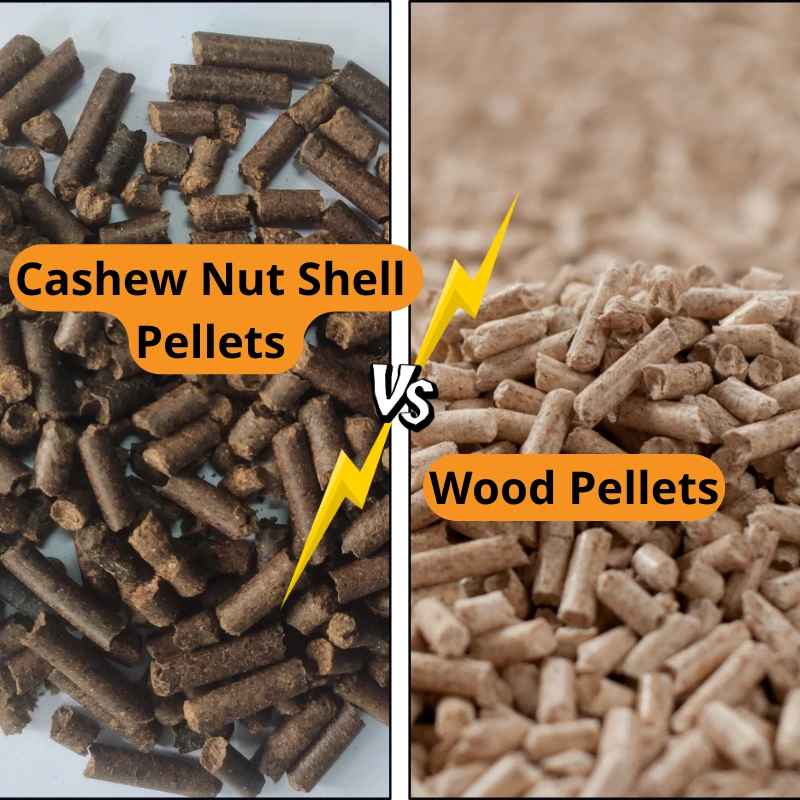
As global industries race to decarbonize operations and shift away from expensive fossil fuels like coal and Heavy Fuel Oil (HFO), biomass pellets have become the primary choice for thermal power and steam generation.
For years, Wood Pellets (pine, acacia, hardwood) served as the default market benchmark. However, Cashew Nut Shell Pellets (CNSP)—manufactured by compressing high-density cashew shell residue after oil extraction—are rapidly superseding traditional wood biomass in high-demand industrial boilers.
This technical buyer’s guide breaks down the performance differences between Cashew Nut Shell Pellets and Wood Pellets across calorific heat value, ash residue, fuel expenditure, and boiler longevity to help plant managers optimize their energy OpEx.
Table of Contents
Technical Side-by-Side Comparison
| Parameter / Specification | Cashew Nut Shell Pellets (CNSP) | Standard Wood Pellets (Pinewood / Hardwood) | Industrial Advantage |
| Gross Calorific Value (GCV) | 4,500 – 5,000 kcal/kg ($18.8 – 20.9\text{ MJ/kg}$) | 4,000 – 4,400 kcal/kg ($16.7 – 18.4\text{ MJ/kg}$) | Cashew Shell (+12% to 15% Heat) |
| Moisture Content | $\le 8\% – 10\%$ | $\le 8\% – 10\%$ | Tie (Both offer fast ignition) |
| Bulk Density | $1,100 – 1,300\text{ kg/m}^3$ | $650 – 750\text{ kg/m}^3$ | Cashew Shell (Higher thermal density per volume) |
| Ash Content | $2.5\% – 4.5\%$ | $1.0\% – 2.5\%$ | Wood Pellets (Slightly cleaner combustion bed) |
| Fixed Carbon | $18\% – 22\%$ | $12\% – 15\%$ | Cashew Shell (Sustained ember temperature) |
| Volatile Matter | $65\% – 72\%$ | $75\% – 82\%$ | Cashew Shell (Less immediate gas loss) |
| Fuel Feed Rate Required | Lower ($\approx 12-15\%$ less mass per hour) | Higher | Cashew Shell (Reduces feeder wear & tear) |
| Steam Cost Savings | 15% – 25% Reduction | Baseline Standard | Cashew Shell (Substantially lower OpEx) |
1. Calorific Value & Flame Temperature: Cashew Nut Shell Pellets Win
The single most critical factor in boiler efficiency is the Gross Calorific Value (GCV).
- Wood Pellets: Average between 4,000 and 4,400 kcal/kg. While suitable for standard heat generation, maintaining high-pressure steam outputs requires feeding larger volumes of wood pellets into the furnace.
- Cashew Nut Shell Pellets: Deliver a superior energy output ranging from 4,500 to 5,000 kcal/kg.
- Why the difference? Raw cashew shells naturally contain residual Cashew Nut Shell Liquid (CNSL)—an organic resin rich in cardanol and anacardic acid. Even after oil processing, the remaining fibrous matrix possesses higher fixed carbon content, yielding an intense, stable flame with significantly greater thermal output.
Operational Result: An industrial plant replacing wood pellets with CNSP can achieve the same steam output while consuming 12% to 15% fewer metric tons of fuel per shift.
2. Volumetric Density & Logistics Costs
Boiler fuel efficiency is not just about weight—it is also about volume.
- Bulk Density: Cashew shell pellets are compressed under intense mechanical pressure, reaching a high bulk density of $1,100 – 1,300\text{ kg/m}^3$, compared to wood pellets ($650 – 750\text{ kg/m}^3$).
- Storage Efficiency: Because CNSP packs nearly double the weight per cubic meter, factory storage hoppers hold significantly more thermal energy per square foot.
- Freight Savings: High volumetric density allows exporters and buyers to maximize container payloads (FCL weight limits) without running out of cubic volume, lowering sea freight and inland trucking costs per Gcal.
3. Ash Content & Boiler Maintenance: The Trade-Off
A key concern for boiler engineers is ash build-up and grate slagging.
- Wood Pellets: Produce very low ash content ($1.0\% – 2.5\%$). This ensures clean combustion grates, minimal ash disposal, and lower frequency of heat-exchanger cleaning.
- Cashew Shell Pellets: Yield slightly higher ash residue ($2.5\% – 4.5\%$).
- Engineering Solution: Modern industrial chain-grate, reciprocating-grate, or fluidized-bed boilers equipped with automated de-ashing systems process $3-4\%$ ash effortlessly. The slight increase in ash handling is vastly outweighed by the 15–25% overall reduction in fuel costs.
4. Cost Efficiency & Price Stability
Fuel expenditure accounts for over 70% of total operational costs in industrial boiler facilities.
- Stable Agricultural Supply: Wood pellet pricing is volatile and heavily impacted by forestry restrictions, timber industry shifts, and furniture manufacturing waste cycles. Conversely, Vietnam is the world’s largest processor of cashew nuts, producing a continuous, year-round supply of cashew shell raw material.
- Lower Cost per Ton of Steam: Because CNSP delivers higher kcal per kilogram at a lower average FOB/CIF price point, industrial plants consistently save between 15% and 25% on total steam generation expenses compared to wood biomass.
Final Verdict: Which Biomass Pellet Should You Choose?
- Choose Wood Pellets if: You operate a small manual boiler lacking automatic ash removal, or your facility has strict zero-modification constraints regarding combustion ash tolerances.
- Choose Cashew Nut Shell Pellets if: You operate medium-to-large industrial boilers (textile dyeing, food processing, paper mills, chemical processing, or seafood freezing plants) seeking to cut fuel costs per ton of steam, increase boiler heat output, and secure a stable, high-calorific biomass supply chain.
Source High-Calorific Cashew Shell Pellets with The One General Trader
At The One General Trader, we specialize in exporting export-grade Vietnamese Cashew Nut Shell Pellets engineered for maximum industrial boiler performance. Our pellets feature tight specification controls:
- Diameter: 8 mm – 10 mm
- Calorific Value: $> 4,600\text{ kcal/kg}$
- Moisture Content: $\le 8\%$
- Impurities: 0% (Pure cashew shell byproduct, no sand or chemical additives)
Ready to reduce your plant’s energy bills and optimize steam output?
Contact The One General Trader team today to request full lab analysis reports (COA), sample shipments, and competitive FOB/CIF price quotes!